Facebook
  • Steel & Aluminum Floor Jack FJA type
  • Steel & Aluminum Floor Jack FJA type

Steel & Aluminum Floor Jack FJA type

No.808003

The H-Lift FJA Series Hybrid Floor Jack combines a lightweight aluminum chassis with a robust steel lifting arm, offering the perfect balance of portability and durability. This racing-style jack features convenient side handles for easy transport and a rapid-action dual pump system to reach working height in fewer strokes. Ideal for trackside use and mobile mechanics, it delivers high-performance lifting for sport and custom vehicles while minimizing user fatigue.

  • Hybrid construction: Aluminum frame for low weight, steel arm for strength
  • Dual-piston pump system for rapid lifting (Quick Lift)
  • Side-mounted handles for easy carrying and positioning
  • Low profile design for access under high-performance vehicles
  • Built-in overload protection and foam-padded handle
  • Technical Data

  • Safe Use of Jacks

  • Floor Jack

The FJA Series Hybrid Floor Jack combines a durable steel frame with a lightweight aluminum lifting arm. Weighing as little as 14kg, it features Twin Piston Quick Lift technology and a low profile design, making it the ultimate tool for mobile mechanics and track day enthusiasts.

🧬 Hybrid Construction

Combines a Steel Frame for stability with an Aluminum Lifting Arm. This unique design significantly reduces weight without compromising structural strength.

⚡ Quick & Low

Quick Lift: Twin Piston Pump raises the saddle in minimal strokes.

Low Profile: Min. height of 89mm (1.5T) or 86mm (2T) for sports car access.

🪶 Ultra Lightweight

Weighing just 14kg (1.5T) or 19.5kg (2T), these jacks are easy to carry. Equipped with side carry handles and steel swivel casters for smooth mobility.

🛡️ Safety & Protection

Built-in Overload Protection System prevents lifting beyond capacity. Includes a Foam Bumper on the handle to protect vehicle bodywork.

Q: What is the benefit of a hybrid steel/aluminum jack? A: A hybrid jack offers the best of both worlds: the strength and durability of a steel frame with the lightweight portability of aluminum components. It is easier to transport than full steel jacks but stronger than some full aluminum models.
Q: Is the FJA jack suitable for low cars? A: Yes, the 2 Ton model has a minimum height of just 86mm, making it an excellent choice for lifting sports cars and vehicles with lower ground clearance.
ℹ️ Full Steel Option: For heavy-duty workshop use where weight isn't a concern, see our Steel Floor Jacks FJH Type.
⚠️ SAFETY ESSENTIAL: Never work under a vehicle without using Rated Jack Stands.

Technical Specifications

← Swipe table left and right to view all data →
Item No. Capacity Min. Height Max. Height Lifting Height N.W. Product Code
t mm mm mm kg
FJA-015 1.5 89 359 270 14 808003020
FJA-020 2 86 418 332 19.5 808003120

Selecting the Correct Jack

Jacks may be hydraulic or mechanical in operation and are available in a wide range of capacities and designs. Proper selection is critical for safety.

Key Considerations:

  • Type: Hydraulic, ratchet, screw, or journal jack.
  • Dimensions: Capacity, closed height, lifting height, and overall dimensions.
  • Accessories: Toe/claw attachments, screwed ram with locking collar, calibrated gauges for load measurement.
  • Support: Packing materials needed during jacking and to support the load once raised.

Safety Guidelines

Always

  • Store and handle jacks correctly.
  • Inspect jacks before use and before placing into storage.
  • Ensure the surface is level, even, and capable of taking the imposed load.
  • Ensure the jack is positioned so the load is applied in the correct plane.
  • Use packing capable of withstanding loads without crushing.
  • Lift and lower in small stages using support packing to minimize load falls.

Never

  • Never obliquely load (side load) jacks.
  • Never raise the load higher than necessary.
  • Never over-extend the jack beyond its rated stroke.
  • Never leave a load supported solely on jacks (use stands/packing).
  • Never reach under a load supported by jacks.
  • Never work or climb on a load supported by jacks.

Operation & Maintenance

Using Jacks Safely

Multiple Jacks: Most operations require multiple jacks. It is impossible to raise/lower them in perfect unison, causing uneven loading. Ensure jack capacity is adequate to handle load transfer. Keep the load level.

Floor Stability: Ensure the floor can withstand the point load. Use floor plates to spread the load if necessary. Avoid buried cables or pipes.

Contact: The jack head must be in full, firm contact with the jacking point. Use packers to prevent slipping.

Storage & Handling

Store jacks upright with the ram/rack/screw fully lowered to protect them from damage. Remove handles/levers and store separately. Never store damaged jacks.

In-service Inspection

Clean jacks regularly to remove dirt from racks, screws, and seals. Check hydraulic oil levels. Lubricate moving mechanical parts.

Defects to Watch For:
  • Failure to lift or lower; load slipping/creeping.
  • Cracked or distorted body/base.
  • Bent operating levers.
  • Hydraulic: Oil leaks, scored/distorted rams, inoperative release valves.
  • Mechanical: Chipped/worn rack teeth or screws, seized swivel heads.
⚠️ WARNING: Excessive grease on ratchet jacks can cause the holding pawl to stick, potentially dropping the load.

Hydraulic Floor Jack

Mobile Garage Jacks with Dual Pump Technology
Quick Lift Low Profile Options Dual Pump Piston Overload Protection

Product Overview

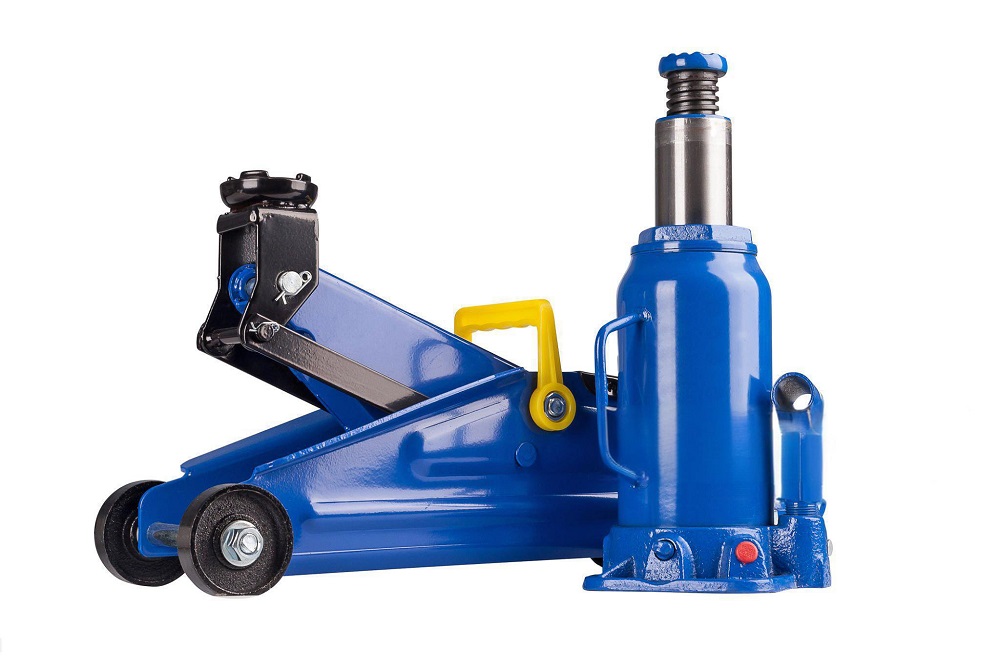
A hydraulic floor jack is a heavy-duty lifting device designed to be positioned horizontally on the ground. Unlike vertical bottle jacks, floor jacks feature a horizontal frame with wheels, offering superior maneuverability and ease of positioning under vehicles.

Common Applications:

  • Automotive Workshops: Daily lifting of cars, SUVs, and trucks for maintenance.
  • Garages: Essential tool for tire changes and under-body repairs.
  • Industrial: Moving and positioning heavy loads where a low pickup height is required.

Key Features & Components

Dual Pump System

Many modern models feature a dual pump piston system, which utilizes both the upward and downward strokes of the handle to lift the load faster than traditional single-pump jacks.

Low Profile Design

Specialized low-profile models are available to fit under sports cars or vehicles with low ground clearance, while High Lift versions provide extra height for trucks.

Maneuverability

Equipped with rear swivel casters and a long handle, allowing for precise positioning of the lifting pad under the vehicle's designated lift points.

Swivel Saddle

The lifting pad often rotates 360 degrees, allowing for secure contact with the vehicle chassis regardless of the approach angle.

⚠️ Safety Precautions

To prevent accidents and equipment failure:

  • Jack Stands: Never rely on the jack alone. Once lifted, immediately support the load with rated jack stands.
  • Surface: Always operate on a stable, level, and hard surface (e.g., concrete).
  • Overload Protection: Built-in valves prevent lifting loads beyond the rated capacity.
  • Controlled Descent: Operate the release valve slowly for a safe, controlled lowering of the load.

Maintenance Guidelines

Regular maintenance extends service life:

  • Fluid Levels: Check hydraulic fluid levels regularly. Low oil can cause the jack to fail to reach full height.
  • Lubrication: Grease the wheels, casters, and lifting arm pivot points periodically.
  • Leak Check: Inspect the hydraulic ram and pump seals for oil leaks.

Typical Specifications

Model Type Capacity Min. Height Max. Height Application
Low Profile 2 - 3 Ton 75 mm 500 mm Sports Cars, Sedans
Standard / Garage 3 - 4 Ton 130 mm 460 mm SUVs, Light Trucks
High Lift 3 Ton 190 mm 800 mm Off-Road Vehicles, High Chassis

Download

We use cookie to improve your online experience. By continuing browsing this website, we assume you agree to our use of cookie.