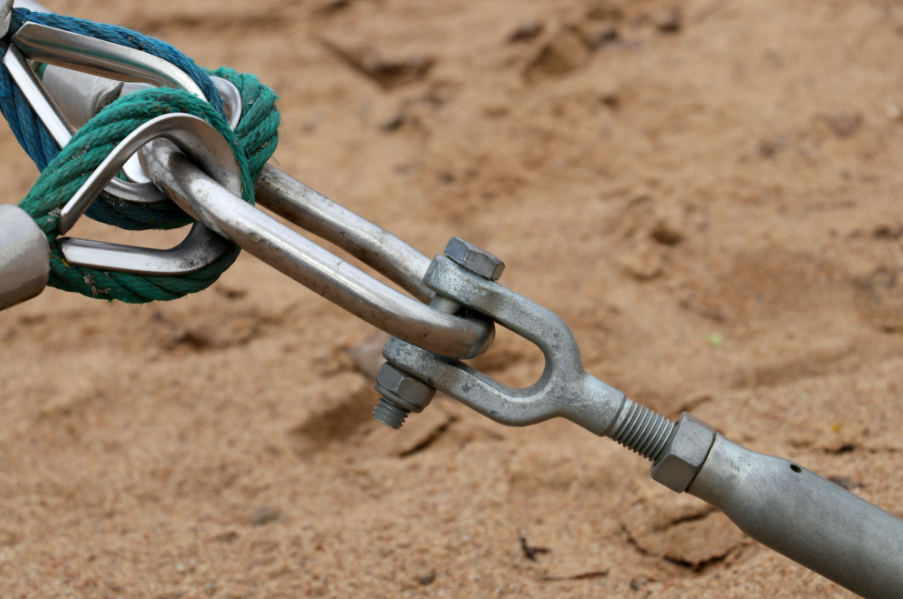
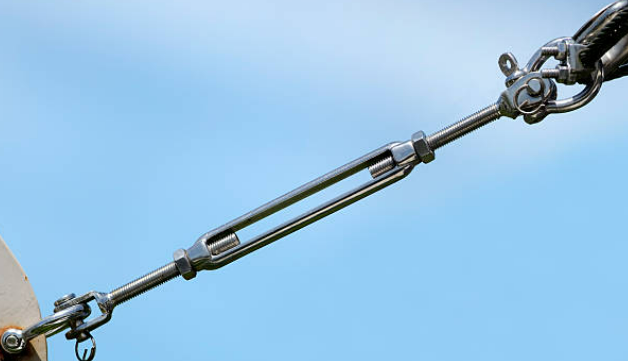
A turnbuckle (also called a bottle screw or stretching screw) is a mechanical device used to adjust the tension or length of ropes, cables, tie rods, and other tensioning systems. It consists of two threaded eye bolts (or hooks/jaws) connected by a metal frame, typically with left-hand and right-hand threads. When you rotate the central body, the fittings move closer together (to increase tension) or further apart (to loosen).
The Main Parts of a Typical Turnbuckle:
- Body/Frame: The central piece, often cylindrical or hexagonal, that houses the internal threads.
- End Fittings: The connection points at each end—commonly available in eye, jaw, or hook types.
- Threads: Internal threads inside the body allow for opposite movement of the fittings when rotated.
- Lock Nuts / Jam Nuts (optional): Used to lock tension in place once adjusted.
- Material Finish: Galvanised or stainless steel, depending on environment and application.
Types of Turnbuckles:
- Hook & Hook – Ends have hooks for quick attachment.
- Eye & Eye – Ends have loops (eyes) for permanent fixing.
- Jaw & Jaw – Ends have swivel jaws for secure connections.
- Hook & Eye / Hook & Jaw – Mixed ends for versatility.
Common Uses of Turnbuckle:
Turnbuckles are used in a wide variety of sectors and tasks:
- Construction & Engineering: Adjusting bracing cables, steel structures, and bridges.
- Marine/Rigging: Tightening sailboat shrouds, stays, and wire ropes.
- Aircraft & Automotive: Control cable tensioning.
- Fencing & Gates: Maintaining wire tension.
- Stage & Theater: Securing rigging for lights and scenery.
Choosing the Right Turnbuckle
To ensure safety and performance, consider:
- Load capacity / WLL
- Material finish (galvanised vs stainless)
- End fitting type (eye, jaw, hook)
- Environment (indoors, marine, corrosive)
- Thread type (metric or imperial)


